The Sterility Assumption: Microbial Evidence Missing from Many UK CBD Certificates
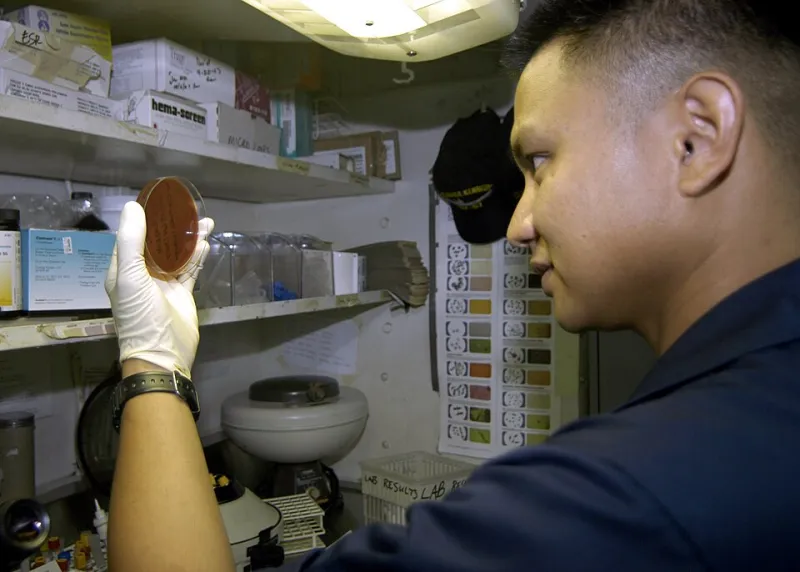
Photo: U.S. Navy photo by Photographer's Mate Airman Tommy Gilligan, Public domain, via Wikimedia Commons
A certificate of analysis (COA) for a UK CBD product often arrives with an impressive set of figures: cannabinoid potency, heavy-metal results, perhaps pesticide residues and a residual-solvent screen. For many buyers, that feels like a complete account of quality. Yet one important area can be missing entirely: microbiology.
The absence of a microbial section is not proof that a product is contaminated. It is, however, a gap in the evidence. For a product taken orally, the question is not only how much CBD the bottle contains, but whether the material has been produced, handled and packed under conditions that keep microbial risk in check.
Why a Low-Water Oil Is Not Automatically Sterile
CBD oils are typically low in water. That is a genuine safety advantage: microorganisms need water to multiply, and a low water-activity value makes active growth unlikely. But low water activity is a hurdle, not a sterilisation step. It does not necessarily kill bacteria, yeast or mould already present. Some organisms can survive in a dormant state, and spores are particularly resilient.
Contamination can also enter after extraction. Dilution, filling, capping, storage and repackaging all create opportunities for organisms to be introduced from the environment, equipment or human contact. A clean extraction process is important, but it is not the whole story. This is why a certificate that documents cannabinoids and metals but omits microbiology leaves a practical question unanswered: what evidence exists that the finished batch was made and handled hygienically?
The Organisms a Microbiological Screen Looks For
A useful microbiological screen is not a single test. It usually combines enumeration of general microbial load with checks for specified organisms. The exact panel should reflect the product type, the intended route of administration and the manufacturer's risk assessment, but common elements include:
- Total aerobic microbial count (TAMC): an indicator of overall bacterial load under aerobic conditions.
- Total yeast and mould count (TYMC): a check on fungal contamination, including yeasts and moulds that may affect shelf life and safety.
- Bile-tolerant gram-negative bacteria: a group used as an indicator of hygiene and of possible contamination with organisms of faecal or environmental origin.
- Specified organisms: depending on the product and specification, tests may look for organisms such as Escherichia coli, Salmonella spp., Staphylococcus aureus or Pseudomonas aeruginosa.
These tests are not interchangeable. A total count tells you about the general microbial burden. A specified-organism test tells you whether a particular hazard has been detected. A certificate that says only "microbiology: pass" without naming the tests, methods and limits is difficult for a buyer to interpret.
What Water-Activity Data Can and Cannot Do
Water-activity testing is valuable. It supports shelf-life decisions and helps demonstrate that a product formulation is unlikely to support microbial growth. But it cannot substitute for a microbiological screen. Water activity describes the availability of water in the product; it does not establish whether viable organisms are present.
A low water-activity result and a clean microbial screen answer different questions. The first says that the product environment is hostile to growth. The second provides evidence about the microbial state of the batch at the time of testing. A buyer should be wary of any argument that one makes the other unnecessary. For a low-water oil, the microbial risk may be lower than in a water-rich product, but lower is not the same as absent.
Reading a Microbiological Section on a UK COA
When a COA does include microbiology, read it as critically as you would a potency result. Look for the batch code, the testing laboratory, the method used and the specification applied. The result should be traceable to the batch in front of you, not to a generic product name or an earlier production run.
Check whether the laboratory's accreditation covers the microbiological methods concerned. UKAS accreditation is not a guarantee that every test on a certificate is within scope, so the schedule or scope should be checked where this information is available. A method reference such as a Pharmacopoeia chapter or an ISO standard is useful, but only if the reported result and limit are clear.
A well-presented micro section will normally state the test, the result, the unit and the limit. For enumeration tests, that may mean colony-forming units per gram or millilitre. For absence tests, it should state the amount tested and whether the organism was detected. Vague wording such as "within limits" without the underlying figures is a prompt for further questions.
Practical Questions for UK Buyers
If a UK CBD certificate stops at cannabinoids and heavy metals, the following questions are reasonable:
- Was the finished batch screened for TAMC and TYMC?
- Was a bile-tolerant gram-negative screen performed?
- Which specified organisms were tested, and what were the limits?
- Were the tests carried out on the finished oil or only on an earlier extract?
- Which methods were used, and are they within the laboratory's accredited scope?
- Has the product been tested again after any repackaging or relabelling?
- What controls prevent microbial contamination between testing and filling?
These questions do not assume that every product is unsafe. They simply ask for evidence proportionate to the product's use. A manufacturer may have a sound risk assessment that explains why a particular panel was chosen. What matters is that the reasoning is available and that the certificate supports the claim being made.
Bringing Microbiology into the Buying Decision
For UK buyers, a COA is most useful when it reflects the whole risk profile of the product, not just the commercial headline of potency. Cannabinoid figures sell bottles; heavy-metal and pesticide results address important chemical hazards; microbiological evidence addresses a separate set of risks arising from raw materials, process hygiene and post-production handling.
A missing micro section should not be treated as automatic condemnation, but it should be recognised for what it is: an unanswered question. In a market where traceability and laboratory testing are central to trust, the microbial side of the certificate deserves the same scrutiny as the cannabinoid percentage.