Reading Between the Results: Seven COA Warning Signs for UK CBD Buyers
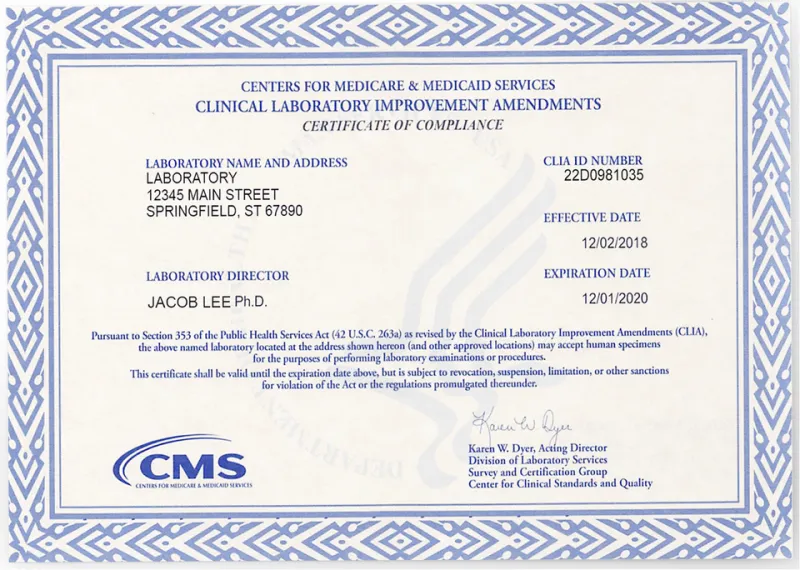
Photo: Centers for Medicare & Medicaid Services, Public domain, via Wikimedia Commons
A certificate of analysis is one of the few pieces of evidence that can separate a genuinely tested CBD product from one that merely uses the language of testing. In 2026, UK buyers are faced with a crowded market, and the phrase 'lab-tested' appears on almost every label. The COA is where that claim should become specific. It should name the laboratory, identify the batch, list the methods and report the results in units that can be checked. The seven red flags below are not proof of fraud on their own, but each is a reason to pause and ask for more information.
Why the COA matters more than the badge
A COA is a record of a sample tested against defined methods. It is not a certificate of quality in the abstract, and it is not a marketing brochure. A useful report allows a reader to connect a product in hand to a laboratory result. Without that connection, 'lab-tested' is a claim about a process that may have happened somewhere, at some time, to something. For UK buyers, the relevant question is whether the report relates to the batch being sold and whether the laboratory is competent to perform the tests it reports.
1. No batch or lot number that matches the product
The first red flag is a COA without a batch or lot number, or with a number that does not match the packaging. A report for a generic 'CBD oil' is not batch-specific evidence. A credible document should identify the sample and allow the buyer to cross-check it against the pack. If the product has a batch code on the label, the COA should refer to it. If the COA predates the product's manufacture date by a wide margin, or covers a harvest from an earlier season without explanation, the buyer should ask why.
2. The laboratory is unnamed or cannot be verified
The laboratory should be named. In the UK, buyers can look for accreditation to ISO/IEC 17025 through UKAS, although accreditation is method-specific and should not be assumed from a logo alone. A report that hides the laboratory's identity, gives only a generic email address or displays an accreditation mark without a laboratory name is difficult to verify. This does not automatically mean the results are wrong, but it weakens the chain of evidence. A named laboratory with contact details and a report number is easier to check.
3. Cannabinoid results are incomplete or ambiguous
A cannabinoid profile should go beyond a single CBD percentage. It should show CBD, THC, THCA and, where relevant, other cannabinoids such as CBG or CBN, with units and limits of quantification. The distinction between total THC and delta-9 THC matters, as does the method used. A report that lists 'CBD' without saying whether the figure is by weight, by volume or per serving is not enough. A report that gives a potency figure with no limit of quantification or method reference is similarly weak. Buyers should be able to see what was measured and how.
4. Contaminant testing is missing
Cannabinoid potency is only part of the picture. A credible COA for a CBD product should address contaminants relevant to the plant and the extraction process. These typically include heavy metals, pesticides, mycotoxins, residual solvents and microbiological safety. Not every product requires every test at the same frequency, but the absence of any contaminant panel should prompt questions. A report that tests only for CBD is a potency report, not a full safety report. For UK buyers, this distinction is important because the label often implies a level of testing that the COA does not actually demonstrate.
5. Dates, sample details and product details do not add up
The dates on a COA should tell a coherent story. When was the sample taken? When was it tested? When was the report issued? Does the sample date fall within the production window? Does the report refer to the same product format, strength and pack size as the one being sold? A report that is undated, or that refers to a different strength or flavour, is not reliable evidence for the product in question. Small inconsistencies matter because they break the link between sample and sale.
6. The document looks like a template or has been edited
A COA should look like a laboratory document, not a designed marketing asset. Warning signs include generic headers, missing page numbers, cropped logos, inconsistent fonts, blank result fields and signatures that cannot be verified. Some laboratories issue simplified reports for consumers, which is not automatically a problem, but the underlying data should still be coherent. Buyers should be wary of a PDF that contains only selected results and no laboratory contact details. If the document cannot be checked, it should not be treated as strong evidence.
7. The numbers do not reconcile with the label or the price
Finally, the COA should reconcile with the label. If a product claims a certain CBD content per bottle, the report should support that claim once dilution and serving size are considered. If the price is unusually low for the stated potency, or unusually high for a modest result, the buyer should ask what is being paid for. Price per milligram of CBD is a useful comparison, but it is not a quality score. The COA should also be consistent with the product's batch code, manufacture date and country of origin. A mismatch is a reason to seek clarification before purchase.
A practical checklist for 2026
Before buying a CBD product, UK consumers can ask five simple questions. Does the COA name the laboratory and report number? Does it identify the batch that matches the pack? Does it show cannabinoids, including THC and THCA, with units and limits? Does it include contaminant testing? Are the dates and product details consistent? A 'yes' to all five does not guarantee a product is right for every individual, but it does show that the testing claim has substance. In a market where 'lab-tested' is easy to print, the COA is the document that makes the claim accountable.