Accredited to What, Exactly? Reading UKAS Scope on a UK CBD Certificate
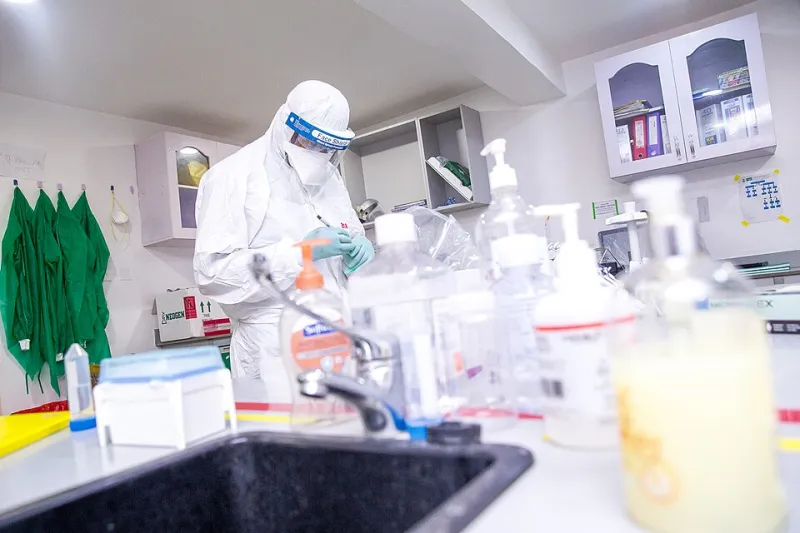
Photo: Rubbyfem, CC BY-SA 4.0, via Wikimedia Commons
A certificate of analysis arrives with a logo, a registration number and a column of results. For many buyers, the presence of a UKAS mark settles the matter. It does not. Accreditation is a statement about a laboratory's competence to perform defined tests on defined materials, and it is only as meaningful as the scope behind it. In 2026, as the UK CBD market continues to mature under novel food controls, knowing how to read that scope is a basic part of buyer diligence.
What the mark is designed to confirm
UKAS is the national accreditation body for the United Kingdom. Laboratories that hold accreditation to ISO/IEC 17025 have been assessed against an international standard for testing and calibration competence. That assessment covers staff competence, equipment calibration, method validation, traceability of measurements, environmental conditions, record keeping and quality management. UKAS is also a signatory to the International Laboratory Accreditation Cooperation mutual recognition arrangement, which gives its accredited results a degree of international standing.
None of this is trivial. A laboratory that has been assessed in this way has demonstrated a systematic approach to producing reliable data. But the assurance is procedural. It speaks to how a result was generated, not to what the result means for the product in the bottle.
The scope is the substance
Accreditation is not granted to a laboratory in general terms. It is granted for specific activities, and those activities are listed in a schedule of accreditation. This is the document that matters most, and it is the one buyers most often overlook.
The schedule will set out the tests concerned, the methods used, the materials or matrices covered and, in many cases, the analytes within each method. A laboratory may be accredited for cannabinoid potency testing in hemp plant material but not in a finished oil. It may be accredited for lead and cadmium in foodstuffs but not for the full set of heavy metals in a CBD tincture. It may hold accreditation for pesticide residues in certain food commodities while the particular multi-residue method used on a hemp sample sits outside that scope.
Matrix and analyte are not administrative details. They determine whether the result in front of you was produced under the laboratory's accredited system or alongside it.
Where the certificate and the schedule meet
A well-prepared certificate will distinguish between results that fall within the accredited scope and those that do not. Some laboratories use a symbol, footnote or separate column for this purpose. Others do not, and the omission can make an entire certificate look uniformly accredited when only part of it is.
A buyer should therefore read the certificate and the schedule together. If the potency panel is accredited but the pesticide screen is not, the document is not a single piece of evidence. It is a combination of stronger and weaker evidence, and it should be treated as such.
Sampling sits on a separate link in the chain
Accreditation for testing does not automatically extend to sampling. If the laboratory did not take the sample itself, it can attest only to the condition of what it received. The chain from a production batch to the submitted sample involves decisions about homogeneity, subsampling and storage that the testing laboratory may have had no part in.
This does not invalidate a result, but it limits what the result can support. A certificate on a sample selected by the supplier is evidence about that sample. Whether it represents the batch is a separate question, and one that accreditation alone will not answer.
Uncertainty and the decision rule
Accredited results are usually accompanied by a statement of measurement uncertainty. This matters when a result sits close to a legal or internal limit. A pass or fail is not a bare comparison of a number with a threshold; it depends on the decision rule the laboratory has agreed with the client. Simple acceptance and guard-banded approaches can produce different conclusions from the same measurement.
For controlled cannabinoids and for contaminants with tight limits, the decision rule deserves a direct question. A certificate that reports a figure near a limit without explaining how conformity was judged is less useful than it first appears.
What accreditation does not tell you
It is worth being explicit about the limits. Accreditation does not confirm that a product is safe, lawful or correctly labelled. It does not establish that the sample was representative of the batch, that the batch code is genuine or that the product appears on the novel food register. It does not verify the cultivar, the extraction method or the accuracy of the marketing claims that surround the bottle.
It is evidence of testing competence, confined to the methods and materials in scope. That is a valuable thing, but it is a narrower thing than many buyers assume.
How to check a laboratory in practice
Start with the UKAS website and search for the laboratory by name or accreditation number. Open the current schedule and confirm that the method, matrix and analyte on the certificate appear within it. Check that the laboratory name and address on the certificate match the accredited entity, and that the accreditation was in force on the date of testing rather than only at the date of purchase. Look for the certificate number, sample identifier and batch reference, and confirm that an authorised signatory is named. If any part of the work was subcontracted, establish whether the subcontractor is accredited for that work and whether the certificate says so.
Questions to put to a supplier
- Which laboratory produced this certificate, and what is its UKAS accreditation number?
- Which results on the certificate fall within the accredited scope, and which do not?
- Was the sample taken by the laboratory or supplied by the producer?
- What decision rule was applied to any result reported against a limit?
- Was any part of the testing subcontracted, and to whom?
- Does the accredited scope cover the specific matrix, such as a hemp-derived oil, rather than foodstuffs generally?
- Can you provide the current schedule of accreditation alongside the certificate?
A reasonable standard for 2026
An unaccredited certificate is not worthless. It may still be informative, particularly where the laboratory is otherwise reputable and the methods are described clearly. But it is weaker evidence, and it should be described as such. For potency and controlled cannabinoids, and for contaminants where risk is material, accredited methods within a defined scope give a buyer a firmer footing.
The sensible position is neither to worship the logo nor to dismiss it. Accreditation is a floor, not a ceiling. The work of the buyer begins with the schedule behind the stamp.