The Millilitre Before the Milligram: How UK Buyers Can Build a CBD Dose They Can Actually Repeat
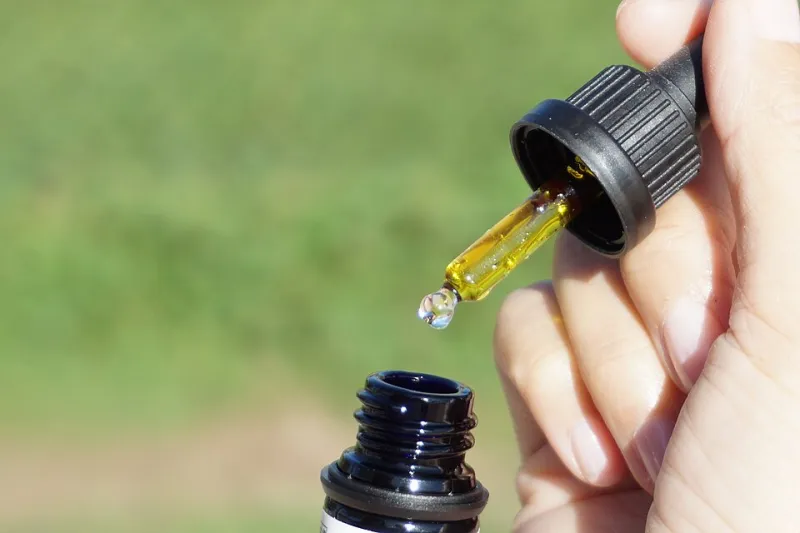
Photo: Elsa Olofsson, CC BY 2.0, via Wikimedia Commons
UK CBD labels are generally careful about milligrams and millilitres. They are much less careful about the humble drop. A bottle may state a total CBD content, a bottle volume and a servings count, but the servings figure is often calculated from an assumed drop size that the dropper was never designed to guarantee. For buyers trying to take a consistent amount, that gap matters. The milligram figure on the box is a statement about the bottle’s contents; it is not a statement about what lands under the tongue from one squeeze.
Why a drop is a poor unit of measurement
A drop is not a fixed unit in the way a millilitre is. It is the result of several interacting variables: the internal diameter of the pipette tip, the flexibility of the bulb, the surface tension of the liquid, the angle at which the bottle is held, the temperature of the oil and the pressure applied by the user. A thin MCT carrier oil will generally flow more readily than a thicker olive-oil base. A cold bottle kept in a kitchen cupboard in winter may dispense differently from the same bottle at room temperature. A gentle squeeze and a firm squeeze can produce materially different volumes over a full bottle.
This is not a reason to distrust every CBD product. It is a reason to treat the dropper as a delivery device rather than a measuring instrument. When a label says that a bottle contains, for example, 200 servings, that claim is usually an arithmetic convenience: total volume divided by an assumed drop volume. It is not a guarantee that 200 identical drops will leave the pipette.
The arithmetic that actually matters
Two numbers do most of the work: the total CBD content of the bottle in milligrams and the total volume in millilitres. From those, a buyer can calculate concentration.
Concentration in mg per ml = total CBD mg ÷ bottle volume ml.
Dose in mg = chosen volume in ml × concentration.
A 10 ml bottle containing 500 mg of CBD has a concentration of 50 mg per ml. A 0.2 ml measure therefore contains 10 mg. A 0.5 ml measure contains 25 mg. The same arithmetic applies across strengths and bottle sizes, provided both figures are stated clearly.
Now consider the servings claim. If a 10 ml bottle is said to provide 200 servings, the implied serving is 0.05 ml. At 50 mg per ml, that is 2.5 mg per serving. But if the dropper actually delivers 0.07 ml per drop, the bottle yields roughly 143 drops, not 200, and each drop contains about 3.5 mg. The bottle has not changed strength. The serving claim has simply been built on a drop size that the user may never achieve.
This is why a ‘servings per bottle’ figure should be read as an estimate unless the label also states the serving volume in millilitres and explains how that volume was derived. A servings count without a millilitre figure is a conclusion without its working.
Reading the label before trusting the servings panel
UK shoppers can check several details before accepting a servings claim at face value.
- Total CBD and total volume. Both should be prominent. A strength such as ‘1000 mg’ means little without the bottle size. The same 1000 mg in 10 ml and 30 ml represents very different concentrations.
- Serving size in millilitres. A label that expresses a serving only as ‘one drop’ or ‘two drops’ gives the buyer no reliable volume to work from. A millilitre figure is more defensible.
- The arithmetic behind the servings count. If the label claims a large number of servings, check whether the implied drop volume is realistic for the carrier oil and dropper supplied.
- Dropper graduations. Some pipettes carry printed marks; many do not. A marked dropper is an improvement, though the markings still need to be legible and appropriate to the volume being measured.
- Batch and testing details. A batch code that links to a certificate of analysis does not solve the drop-size problem, but it does allow the buyer to confirm that the product’s declared CBD content is supported by laboratory testing.
- Carrier oil and storage advice. Viscosity affects drop behaviour. Storage instructions affect viscosity. Both belong in the buyer’s assessment.
Packaging design also deserves scrutiny. A dropper with a narrow, rigid tip may behave differently from one with a wider opening. A bulb that requires considerable pressure may encourage over-squeezing. A bottle that is difficult to hold at a steady angle makes repeatability harder. None of these details is usually advertised, but they are part of the measuring system whether the label acknowledges it or not.
Why a graduated oral syringe is the better tool
For buyers who want a repeatable volume, a graduated oral syringe is generally more reliable than a dropper. A 1 ml syringe with fine graduations allows the user to draw a specific volume, check it against the scale and dispense it deliberately. The measurement is visible before delivery rather than inferred afterwards.
A practical routine is straightforward. Draw the oil slowly, invert the syringe if necessary to bring air bubbles to the top, and adjust to the intended mark. Read the scale at eye level, taking the bottom of the meniscus where appropriate. Dispense directly into the mouth or onto a spoon, then clean the syringe according to the manufacturer’s instructions. Keep a dedicated syringe for the product and do not share it.
This approach does not require the buyer to ignore the label. It simply replaces an assumed drop with a measured volume. The label’s concentration figure then becomes useful: once the volume is known, the milligram amount can be calculated rather than guessed.
A repeatability routine for UK buyers
Consistency is less about finding a perfect dropper and more about removing variables. Record the bottle’s total CBD content and volume, calculate the concentration, and choose a volume in millilitres rather than a number of drops. Use a syringe or a clearly graduated pipette where possible. Note the product batch, the date opened and the storage conditions. If the bottle or carrier oil changes, recalculate rather than carrying over an old drop count.
Buyers using CBD for a health reason should discuss dosing with a healthcare professional, particularly where other medicines are involved. The purpose of measurement is not to replace clinical advice; it is to make sure that the amount actually taken is the amount the user believes they are taking.
As of 2026, UK labelling continues to improve, but the dropper remains an imprecise interface between a carefully tested bottle and the person using it. The milligram is only as reliable as the millilitre beneath it. A servings panel can be a helpful summary, but it is not a measuring instrument. Buyers who want a dose they can repeat should ask for volume, measure volume and treat the drop as what it is: a convenience, not a constant.